

IWM Summer Seminar 2026: Building Careers, Competencies, and Connections

The IWM Summer Seminar 2026 was held on August 19–20. The IWM doctoral programme community came together this time by the River Aura in Turku for one of our now traditional seminars. We enjoyed the late summer, inspiring discussions, and local flavours while learning together and exchanging ideas.
Welcome to Turku and the IWM Summer Seminar
The seminar opened with a welcome by Professor Wallace Moreira Bessa, who introduced the participants to the University of Turku, the venue of the event. He also provided a brief overview of the history of the city and the university, and presented the activities of his Smart Systems research group. This was followed by Professor Matti Vilkko's introduction to the objectives, themes, and program of the IWM Summer Seminar, which focused on career planning, professional visibility, self-assessment, metacognition, and networking among IWM doctoral researchers.
Research Updates and Community Activities
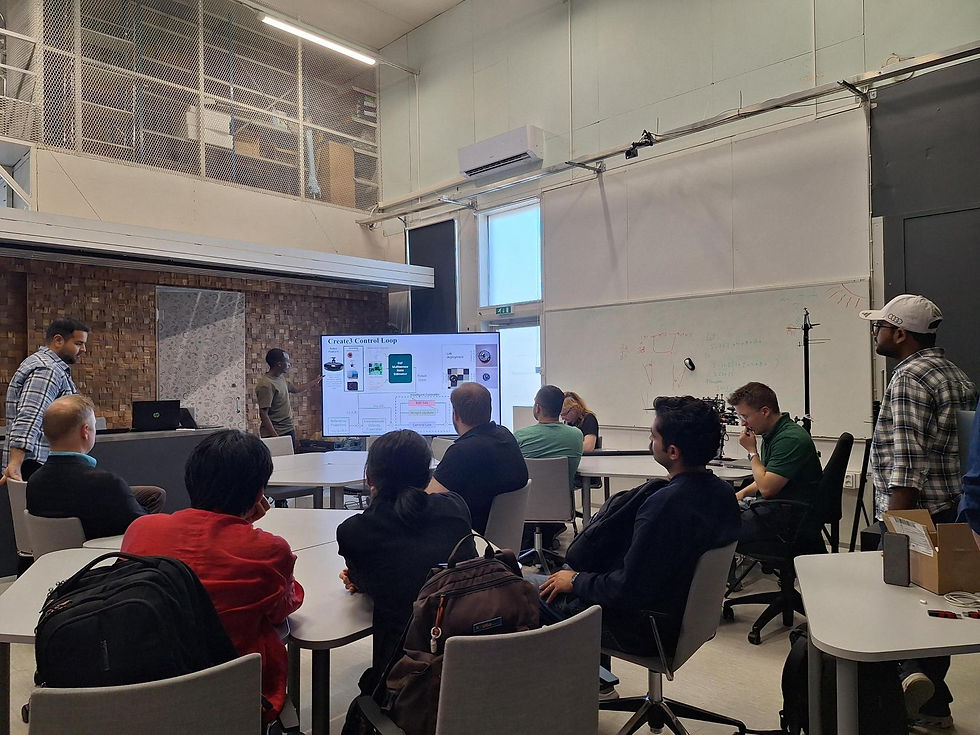
Participants had the opportunity to visit the laboratories of the Smart Systems research group. During the visit, Professor Wallace Moreira Bessa introduced the research activities carried out in the lab, Carlos Cueto Zumaya presented his work on 3D scene graphs, and Amos Alwala shared his research on sensor fusion and intelligent control.
We also received a video greeting from Professor Petri Nokelainen, in which he provided a status update on the longitudinal study of the well-being of the students in the IWM doctoral pilot. The study has now reached its midpoint, and three rounds of questionnaires and interviews have been completed.
Developing Your Career: Strategies and Experiences
In his presentation on career counseling, Professor Emil Kurvinen discussed career paths after the PhD in both academia and industry, emphasizing that career development is rarely linear and requires proactive planning. He encouraged doctoral researchers to identify their career goals, develop their competencies and professional networks through research, teaching and funding activities, seek mentorship, and actively create opportunities for future careers.
We also welcomed two guest speakers from industry who demonstrated how careers can successfully span both academia and industry. Managing Director Markku Noroaho of Kaptas Oy reflected on his experience combining business leadership with academic research, highlighting how research can help address real-world industrial challenges while also reshaping how such challenges are understood, framed, and approached. D.Sc. (Tech.) Lauri Pyrhönen, a Model-Based Design Engineer at Sandvik, shared his journey from academia to industrial R&D and provided a glimpse into his work on electric powertrain technologies.

Understanding and Communicating Your Competencies
Katriina Gafoor from Bruno the Frog emphasized that professional visibility is not self-promotion but a way of making expertise findable, understandable, and memorable. She encouraged the participants to develop an authentic professional brand, communicate their research to different audiences, build bridges outside their immediate research environments, and use social media strategically to create opportunities, networks, and professional recognition.
Coordinator Veera Rautio from Tamlink introduced the CROSS project and its Career Development Companion Tools, designed to support researchers in identifying, developing, and communicating their competences. Building on a homework assignment, the workshop focused on creating competence profiles using the CROSS platform, currently under development within the project. Participants tested different features of the platform and discussed how these could support researchers’ competence development and career planning.
Education Specialist Anna Pasanen (Tampere University) introduced the forthcoming IWM doctoral researcher social media campaign, which aims to increase the visibility of both individual researchers and the IWM community through LinkedIn.
Senior Consultant Titta Collin from MPS discussed enhancing career opportunities and identifying and articulating one’s competencies. Her presentation emphasized that career advancement depends not only on expertise but also on the ability to communicate the value that expertise creates for employers. It provided practical guidance on identifying transferable skills, building a professional narrative, networking effectively, and tailoring CVs, LinkedIn profiles, and job applications to business needs.
Research Impact and Technology Readiness Levels
Professor Matti Vilkko introduced the Technology Readiness Level (TRL) framework, which describes the maturity of a technology through nine levels, from basic research (TRL 1) to full-scale deployment (TRL 9). He noted the connections between TRLs, systems engineering, and new product development, while emphasizing that university research typically operates at TRLs 1 to 4, covering basic research, concept formulation, proof of concept, and laboratory validation. For efficient communication to larger audiences, he recommended that research presentations related to results on a certain TRL clearly illustrate how the proposed solution relates to the lower TRLs and how those stages have been validated.

